AI pedestrian detection
Identifies people inside configured vehicle danger zones without wearable tags.
AI pedestrian detection & collision avoidance camera for industrial vehicles
An AI camera watches the danger zones around your forklifts, warns the operator and supports automatic stopping before contact with a pedestrian — without wearable tags.

Identifies people inside configured vehicle danger zones without wearable tags.
Provides clear visual and audible alerts when a critical approach develops.
Can support vehicle stopping when the control circuit allows a safe integration.
Automatic stop demonstration: the AI camera detects a pedestrian in the forklift path and triggers the stop output before contact.
From detection to action
The camera analyses people in the vehicle path, separates warning zones and sends an alarm output when the risk level changes.
Identify people around the vehicle movement zone.
Analyse distance and the developing trajectory.
Trigger escalating visual and audible operator alerts.
Provide an alarm output for approved vehicle safety logic.
Detection in action
Without detection, the operator finds out about the person at the last moment. With calibrated warning and stop zones, the same situation produces an escalating alert — and, where integrated, a stop signal.
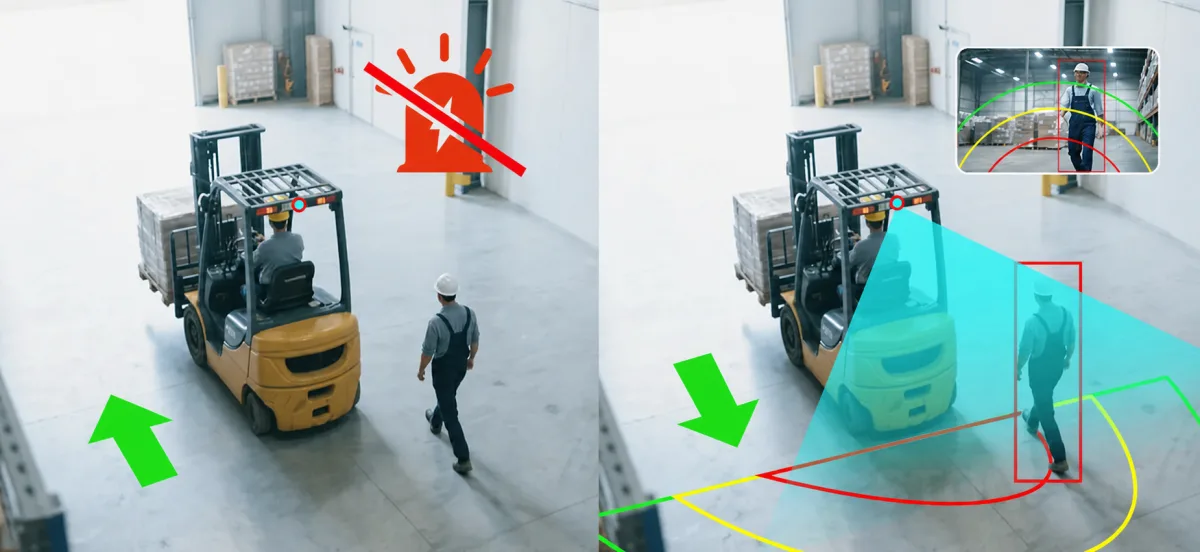
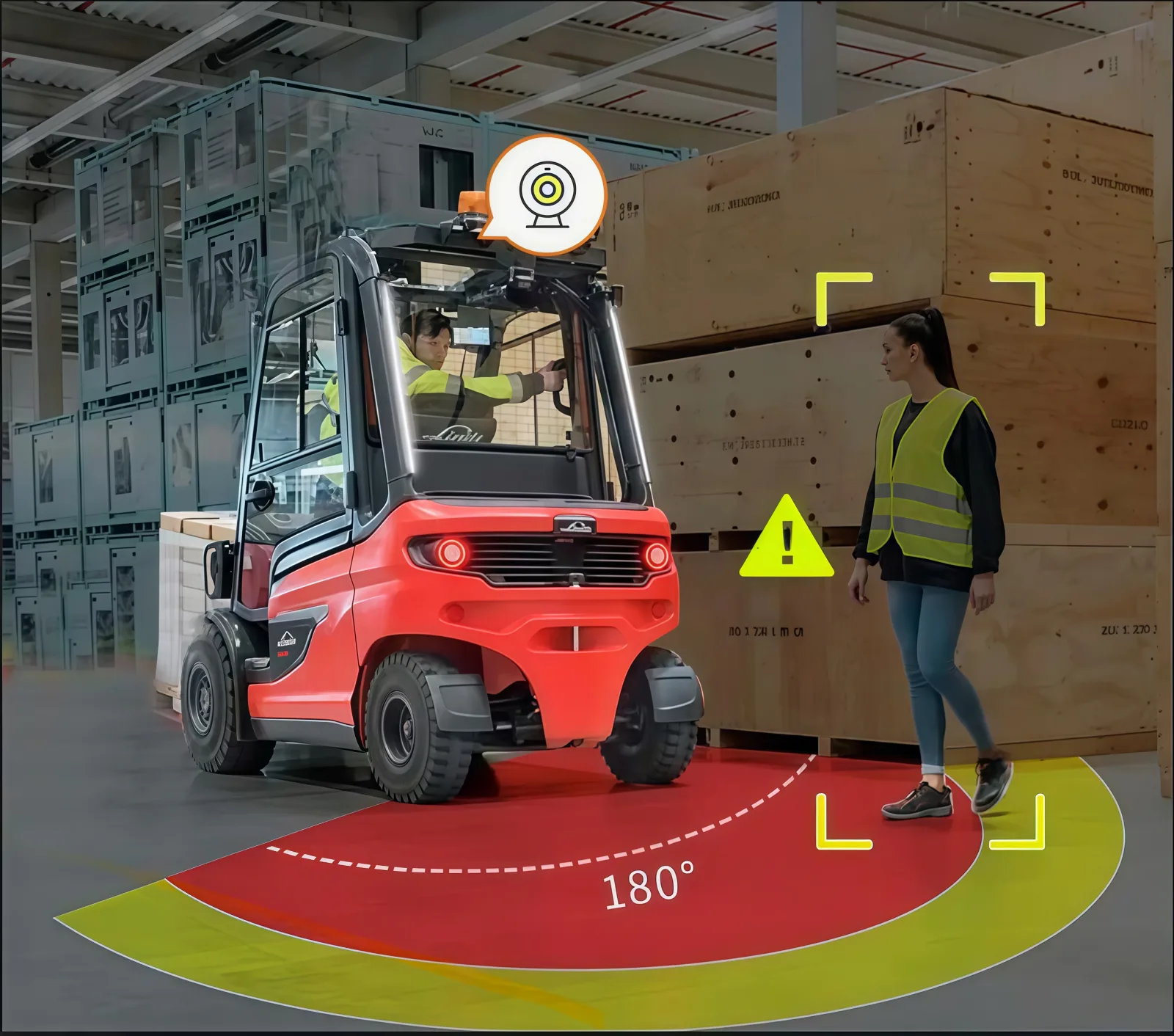

Red dashed area — critical zone (stop output) · Amber dashed area — early-warning zone · Blue frame — pedestrian detected
Blind spot detection and warning zones
Detects a person in near danger zones, including non-ideal body positions and complex manoeuvring scenarios.
Provides escalating warning flow and supports integration with external alarm or blocking logic.
When trajectory risk becomes critical, an alarm output can support stop action instead of warning-only response.
Applications
Racking aisles, dock areas and shared walkways where forklifts and people work in the same space.
Delivery zones and production feeds where visitor and contractor traffic is hard to control.
Mixed traffic of heavy machinery and people, especially at shift changes.
Blind spots around loaders and dumpers are larger; camera zones scale to the machine.
Constant pedestrian–vehicle mixing in tough outdoor conditions.
Deployment
Start with one critical direction or expand coverage across rear, side and front blind spots. The final layout depends on the vehicle and operating process.
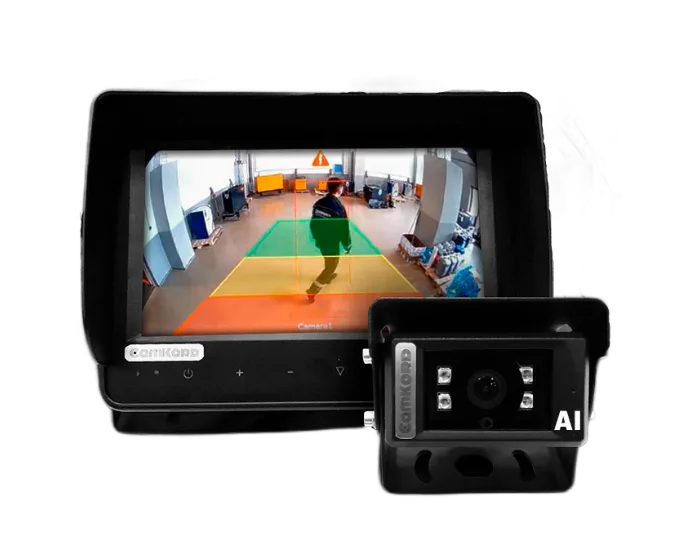
Cover one critical direction or several vehicle blind spots.
Give the operator a clear warning without extra wearable tags.
Select camera positions, monitor placement and wiring for each vehicle.
Connect alarm or stop logic only after the vehicle circuit and operating risks are assessed.
IP69K-rated camera options are available for washdown and outdoor dust; enclosures are selected per site.
Operational value
The system adds a visual detection layer around the vehicle, helping operators respond to people in configured risk zones before a critical approach becomes contact.
A practical pilot starts with one vehicle, one high-risk route and clearly defined warning or stopping behaviour.
Review deployment options →Questions
No. The camera detects pedestrians inside configured risk zones and can provide visual and audible operator warnings. An alarm output can also support vehicle safety logic where a safe integration is possible.
No. The same approach can be adapted to other warehouse and industrial vehicles with blind-spot or mixed-traffic risk.
The system can provide an alarm output for stop-system integration. The final implementation depends on the vehicle control circuit and a safe engineering assessment.
No wearable tag is required for visual pedestrian detection. The camera analyses the scene around the vehicle.
The available industrial camera hardware includes IP69K-rated options. The final enclosure and installation are selected for the operating environment.
Tag-based systems only detect people wearing a tag. The AI camera detects any person inside the configured risk zones visually, so visitors, contractors and unfamiliar staff are protected too — and there are no tag batteries to manage.
Counterbalance forklifts, reach trucks and similar warehouse vehicles are the core use case. The same hardware can be adapted to other industrial vehicles with blind-spot risk after an engineering assessment.
No. It complements workplace transport safety practice such as HSE guidance in the UK and OSHA rules in the US. Physical segregation, training and traffic routing stay primary; detection covers the residual risk in mixed traffic.
Start with the critical route
Vehicle geometry, pedestrian flow and the required operator response determine the camera layout. Share the route and vehicle type to start a technical discussion.
Request a demo